Start here
In one minute
SynthFlag uses a frozen upstream Tu et al. Expert 4 SigLIP encoder and teacher head. Three project-trained lightweight heads correct that teacher margin. Native images at most 64 px use a specialist; larger images use a fixed two-head stack.
Higher means a stronger AI-positive model signal.
What goes in?
One image, eight browser-sampled frames, or a CLI folder.
What happens?
One 384 px SigLIP view is scored through a native-size route.
What comes out?
A continuous score, plus traceable batch or frame metadata.
What does it prove?
Nothing alone. It is a review signal, not origin proof.
01 · Preserve native context
Record size, then create one SigLIP view
Routing uses the original longest side, so dimensions are recorded before RGB conversion and resize.
- Decode and validate the image.
- Record
max(native width, native height). - Bicubic-resize the short edge to 384 px.
- Center-crop to 384 square and normalize with mean/std 0.5.
Input contract
- RGB pixels only
- no EXIF or provenance metadata
- no random inference augmentation
- video audio and motion are not analyzed
02 · Frozen teacher + project heads
The selected graph
Expert 4 produces a pooled 1,152-dimensional feature and two teacher logits. Each residual head adds one learned scalar to the detached teacher margin.
- Teacher: Tu et al. Expert 4, SigLIP So400M Patch14-384.
- Margin:
logit[1] - logit[0]. - Head: LayerNorm → Linear(256) → GELU → Dropout → Linear(1).
- 297,729 parameters per head; 429,414,469 loaded total.
03 · Deterministic route
The exact score conversion
CIFAKE specialist
score = sigmoid(teacher + 1.25 × residual_low)
Fixed two-head stack
Blend corrected epoch-05 and epoch-08 margins 0.65 / 0.35, then subtract -1.557959395647049 before sigmoid.
TEST1 reports threshold metrics at score 0.5. That convention is not a universal production threshold or calibration guarantee.
04 · Public development diagnostic
TEST1 results
clean · 0.9095 composite
clean · 0.8439 composite
clean · 0.8785 composite
TEST1 contains 15,000 unique public sources and 30,000 aligned clean/composite evaluations. It is not TikTok's hidden test. The public suites were previously inspected and native resolution sends all TEST1 CIFAKE images to the specialist.
Research input · Day 3
Professor Ng Teck Khim: a future camera-forensics direction
The SynthFlag team interviewed Professor Ng Teck Khim about local image statistics created by Bayer color-filter sampling and demosaicing. The discussion motivated future tests of small-block variance, cross-channel correlation, mosaic phase, and acquisition consistency.
Interview-derived direction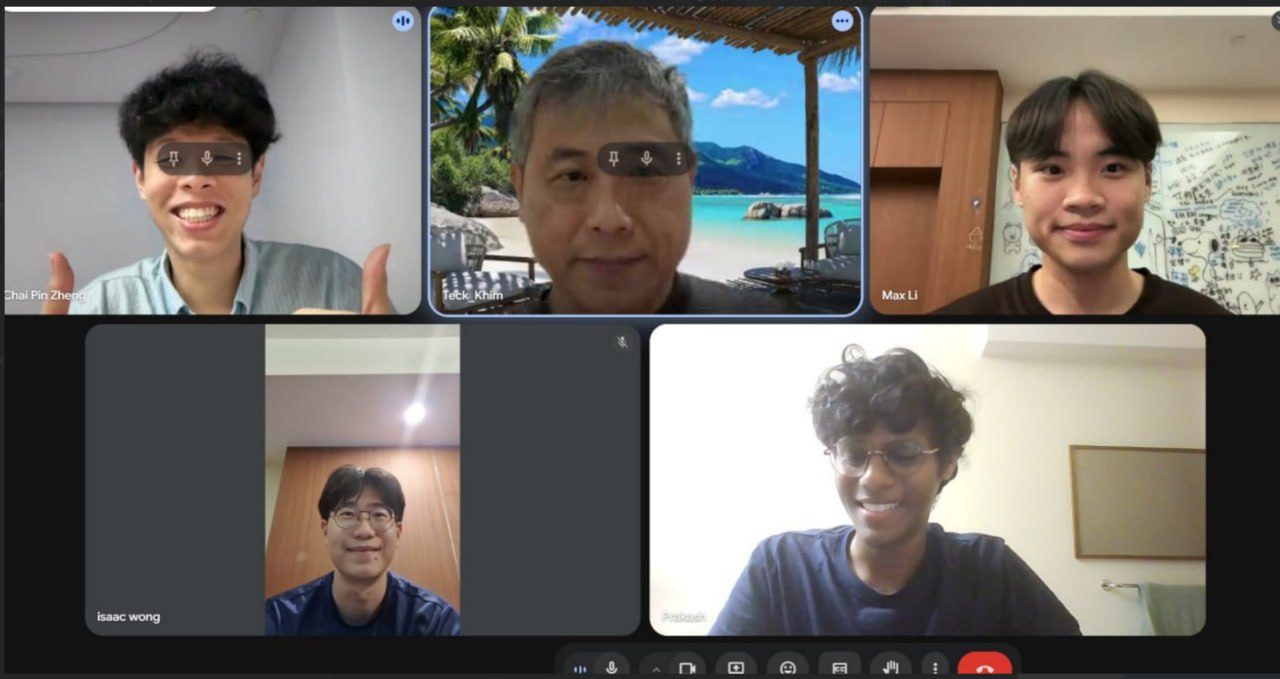
What the interview changed
- Test whether physical-camera statistics complement deep features on the same source-disjoint images.
- Stress blur, resize, JPEG, screenshots, crop, color processing, and deliberate Bayer-statistic injection.
- Validate low-false-positive operating points rather than relying on ROC-AUC alone.
The early prototype was not strong or stable enough for a result. It was not used in the selected Expert 4 plus three-head runtime, TEST1, or final model selection. No performance metric is claimed for it.
05 · Keep the boundary attached
Limitations, rights, and eligibility
Collaborator rights attestation
The collaborator attests that the residual heads and training inputs are rights-cleared for project use. The project owner accepts that assurance; it was not independently audited here.
Expert 4 remains upstream
Its redistribution permission is unproven, and an existing AIGC detector may require explicit organizer clearance.
Both errors matter
SID misses many local tamper positives; composite WildFake produces 861 false positives at the reported boundary.
Use review and provenance
Do not infer creator, generator, edit location, or authentic provenance from one score.
06 · Product contract
Service, video frames, and batch records
One cached model
One active and one queued request; prediction is serialized.
Eight local samples
Only midpoint PNG frames cross the upload boundary.
Resumable output
CSV, atomic Track 5 JSON, and run metadata.
Four file identities
Expert 4 and all three heads pass size/hash verification.
Trace the evidence
Sources and downloads
The retired 18-diagram four-expert atlas remains in repository history as baseline documentation. It is not the selected runtime contract; current behavior is defined by the Expert 4 plus three-head implementation and manifest.