Choose the metric, then protect the answer.
Question: Which representations look promising—and how do we stop ourselves from grading on the test?
Backbone exploration, metric selection, and a protected baseline
We screened several visual representations, then chose ROC-AUC as the primary ranking metric. The close exploratory scores were a direction finder—not a final leaderboard.
Small score gaps need paired confidence intervals and an attached protocol before they can support a model-selection claim.
Team-recorded exploratory screen
Useful direction. Not protected-final evidence.
*The recorded “DINOv3-7” label needs scope confirmation if it refers to a 7B model. Protocol details for this exploratory screen remain to be attached.
An AUC of 0.842 means the system ranks a random generated image above a random real image about 84.2% of the time. It does not mean 84.2% accuracy at one threshold.
Historical V1 protected-final result
Move the operating point—not the ranking model.
The lower threshold caught 481 additional generated images and produced 238 more correct decisions overall. Precision moved from 0.9371 to 0.8764 and specificity from 0.9602 to 0.8995. ROC-AUC stayed 0.8505 because the ranking scores never changed. This was an explicit review tradeoff—not free accuracy—for the retired four-expert runtime. It is not the decision rule for the selected TEST1 graph.
Stress the pixels, then choose complementary views.
Question: What survives compression, resizing, screenshots, and unfamiliar generators?
Retrospective stress tests on the 2,004 calibration rows. Distortion losses varied by source dataset, so the pooled changes are not universal robustness guarantees.
Released architecture
One frozen encoder. Three residual heads.
- Frozen upstream Expert 4 checkpoint
- 27 transformer blocks
- 1,152-D pooled feature
- Two-logit teacher margin
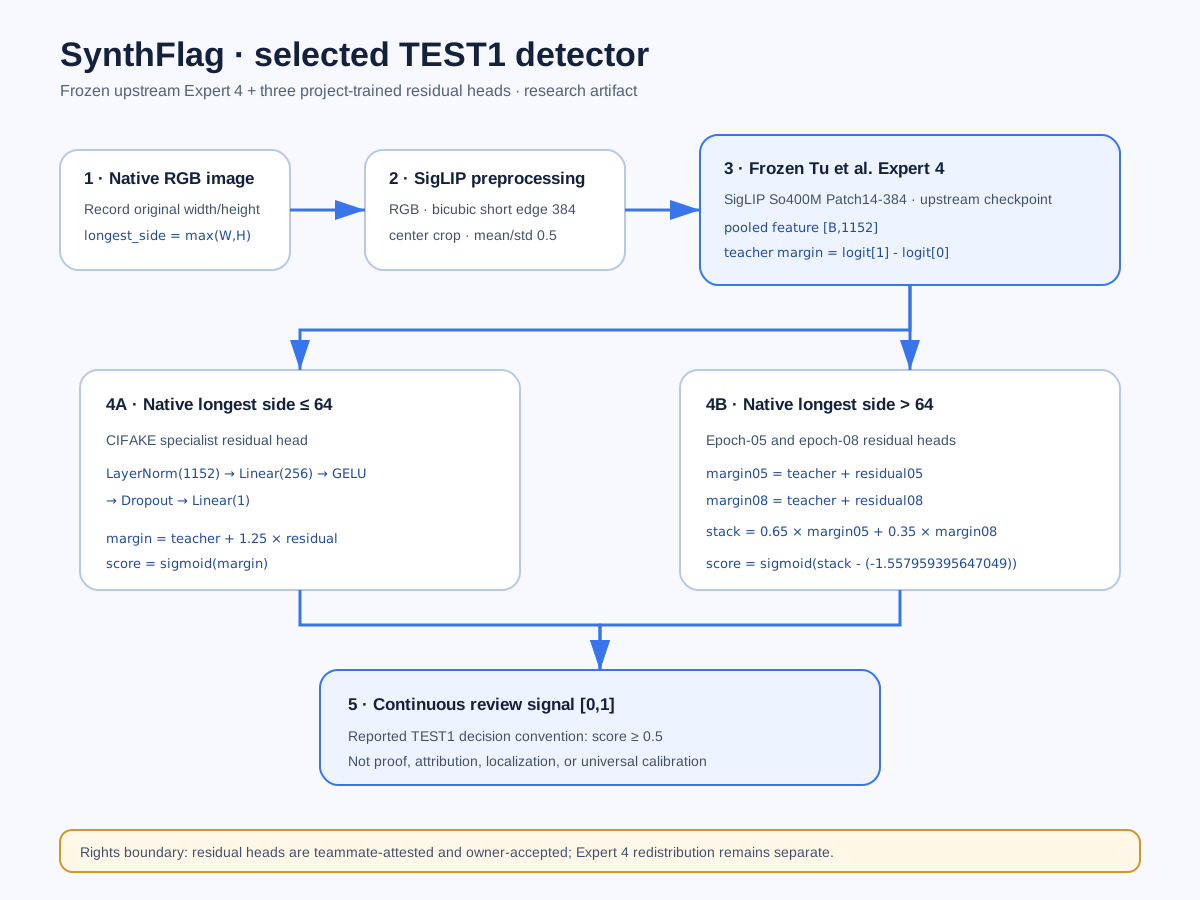
- ≤64 px uses CIFAKE head at α 1.25
- >64 px blends epoch 05 / 08
- Fixed weights 0.65 / 0.35
- Frozen margin boundary -1.55796
Tu et al. supplied Expert 4 and its detector training. SynthFlag does not claim to originate or train that checkpoint. The residual heads and routing are project artifacts with a collaborator rights attestation accepted by the project owner. Expert 4 redistribution and organizer eligibility remain separate.
A library is not a training policy.
12basic operations
19active extended operations
≈35candidate functions
The proposed 20% clean / 40% basic / 40% extended mix is a training design only when connected to a reproducible pipeline. Not every candidate transform reached that state during the sprint.
Selected model · Exact routed graph
Follow one image through your project-trained heads.
Native image size chooses one of two deterministic routes over a frozen Expert 4 representation. The contribution is the three residual heads, their training/evaluation stack, and this fixed routing policy—not the upstream teacher.
Separate the selected heads from rejected shortcuts.
Question: Which adapter experiments failed—and what does the selected graph actually ship?
Historical four-expert adapter experiment
The pooled score rose. The transfer guardrails fell.
Decision: do not promote this adapter. This older experiment belonged to the retired four-expert line; it is not one of the three selected residual heads. It learned shortcuts that looked excellent in pooled development but did not travel reliably. A separate WildFake-excluded run has training OOF numbers, but its actual holdout report is unfinished and is not a generalization result.
Product integration
Then turn evidence into a usable review tool.
Checkpoint hashes, model card, rights notes, release audit.
FastAPI service, resumable batches, serialized accelerator jobs.
Upload workflow, architecture visuals, and technical appendix.
Service connectivity is a live operational state, not model evidence.
Roadmap · Questions worth testing
The next ideas stay visibly on the research side.
Local camera statistics
Professor Ng Teck Khim’s interview prompted a forensic line of inquiry: examine 10 × 10 blocks, cross-channel correlations, and local variance associated with camera acquisition, Bayer sampling, and demosaicing.
Early prototype not stable enough for final use; no metric claimed.Sampled-video delivery
The source now extracts eight midpoint frames in the browser, scores them in two-frame microbatches, and returns a visible timeline with descriptive summaries. Public availability still depends on a connected inference worker.
No temporal understanding is claimed.A staged adaptation ladder—heads, then LayerNorm, LoRA, and final blocks—was proposed for the retired four-expert line. Its head-only adapter was rejected; that result is separate from the three selected residual-head artifacts now shipped.
End-of-sprint truth
Shipped, unfinished, and deliberately not claimed.
Routed residual image inference
Frozen Expert 4 → three residual corrections → native-size route → sigmoid score.
TEST1 public diagnostic
15,000 public sources were evaluated clean and under one deterministic composite view at reported threshold 0.5.
27,265-image benchmark
Extraction work does not equal a final benchmark. No final independent AUC is claimed here.
V3 evaluation
The exact source needed for the planned evaluation was unavailable, so the metric remains unreported.
Score signal—not proof. SynthFlag is a triage aid for human review. It does not prove authorship, localize manipulation, or replace provenance and contextual evidence.
Continue with one clear choice